Combat System
Overview
Star Wars Zero Company uses a turn-based tactical combat system. Missions deploy a squad of four characters. Each character has 3 Action Points (AP) per turn, spent on movement, attacks, and abilities. The squad also shares a single Advantage pool used for special abilities outside the AP economy.
Combat is resolved in team turns: your entire squad acts first, then the whole enemy force takes its turn; actions are not interleaved unit by unit.
Figures on this page were checked against the launch build on 30 Aug 2026. See Game Updates.
Action Points
Every unit begins their turn with 3 Action Points. AP cost varies by action:
- Movement: costs AP based on distance
- Standard attacks: cost AP
- Abilities: cost AP (varies by ability)
Unspent AP does not carry over between turns.
Action Points are spent operator by operator in any order the player likes, and can be interleaved: a squad is free to move one operator, act with a second, then return to the first. The enemy AI plays each of its units out in one go, so this freedom is a player advantage rather than a shared rule, and it is what makes setups like spotting a target before a second operator fires possible within a single turn.
Action Types
Ability cards label each action by type, which tells you which resource it draws on:
| Type | Cost | Notes |
|---|---|---|
| Free Action | None | Costs neither AP nor Advantage. Call for Backup from the Bond System is one. |
| Fast Action | AP | Cheap actions, typically 1 AP. The Fire Blaster Pistol attack, the Scoundrel’s Identify Weakness, and the Scout’s Combat Recon are all Fast Actions. |
| Melee Action | AP | Close-quarters attacks, which move the operator into contact as part of the action. The Soldier’s Brutal Strike costs 1 AP. |
| Special Action | Advantage | The active abilities bought and upgraded in the Focus Tree, paid out of the shared pool rather than from AP. Ultimates are the expensive end of the range; the Sabotage Talent is one of the cheap ones at 2 Advantage. The Scout’s Ambush is the outlier, spending the whole pool instead of a set price. |
| Final Action | All remaining AP | Consumes the operator’s whole AP pool and ends their turn. Fire Repeating Blaster is one, and it converts the AP spent into extra damage; see Weapons. |
Cards also carry their own use limits and targeting mode, independent of cost: many abilities are capped at 1 per turn or a number of uses per combat, and the targeting line states whether the ability hits a Single Enemy, a Target Area, or (for Chained Ranged attacks) any combination of enemies.
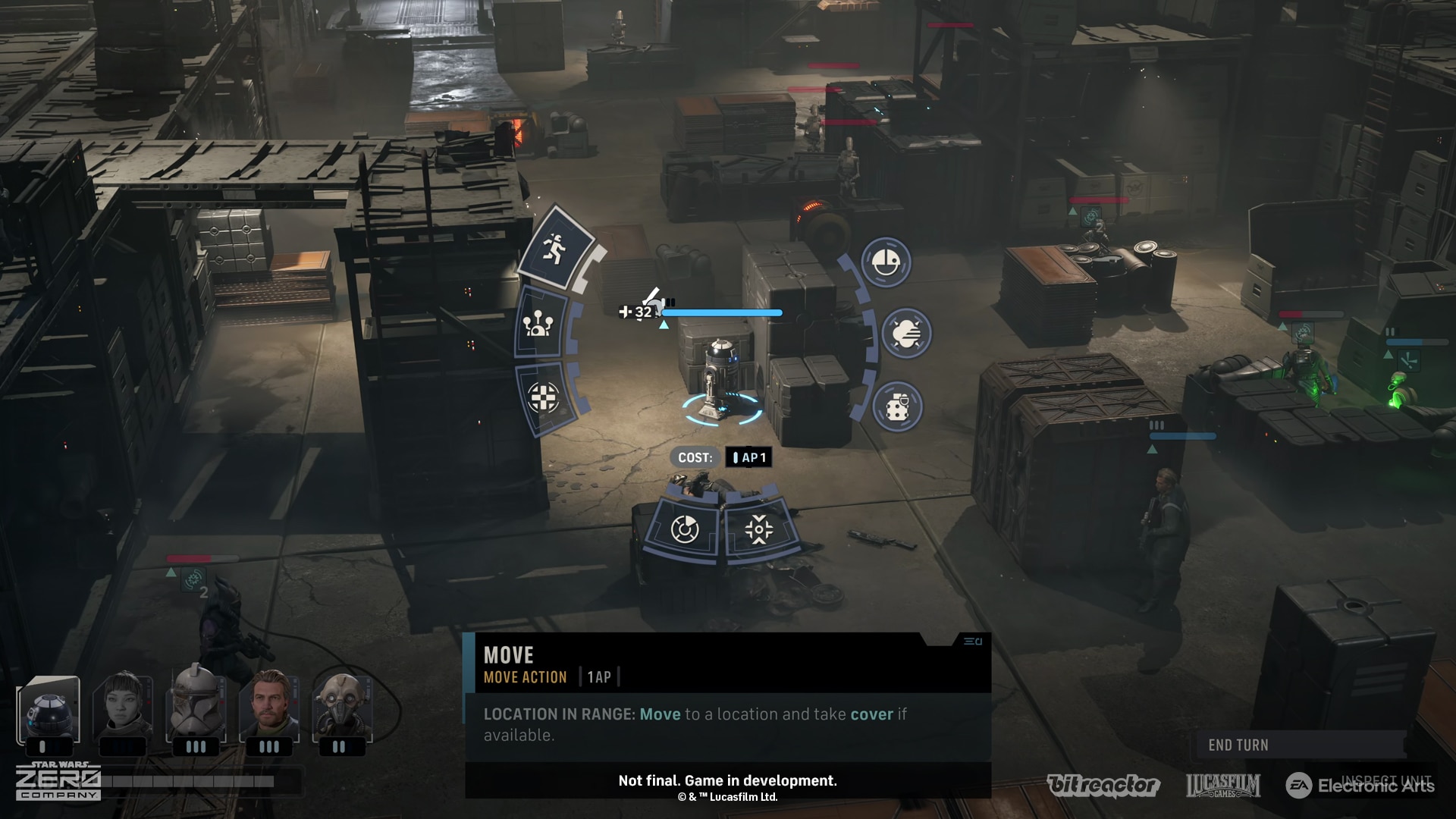
Hawks’ AP ability: Hawks can spend Advantage to refresh 1 AP for any squadmate, once per turn.
Advantage System
The entire squad shares a single Advantage pool, which holds a maximum of 10 Advantage at a time. The squad gains +1 Advantage each time it successfully damages an enemy, so the pool fills through ordinary offence rather than through any dedicated action, and a missed attack generates nothing. Advantage can then be spent on special abilities independently of AP. The Scout is the only class that generates it by other means: Combat Recon grants +1 Advantage for every enemy inside its assessment area, so a tight enemy cluster can be converted straight into pool, and the Tactical Timing passive adds a 20% chance of +1 Advantage whenever that operator defeats an enemy.
- Every class has an Ultimate ability demanding a large Advantage spend; see the ability tables on the Classes page
- Other confirmed Advantage abilities include granting an extra AP to an ally for the turn, calling in a rocket strike, temporarily raising Chance-to-Hit for the entire squad, and taunting nearby enemies into attacking a single operator
- Smaller abilities also draw from the same shared pool
- Advantage spending is a squad-level resource decision, not a per-character one
- Because Advantage doesn’t cost AP, it can rescue a squad after its AP is spent, or set up a calculated burst turn
Hit Chance
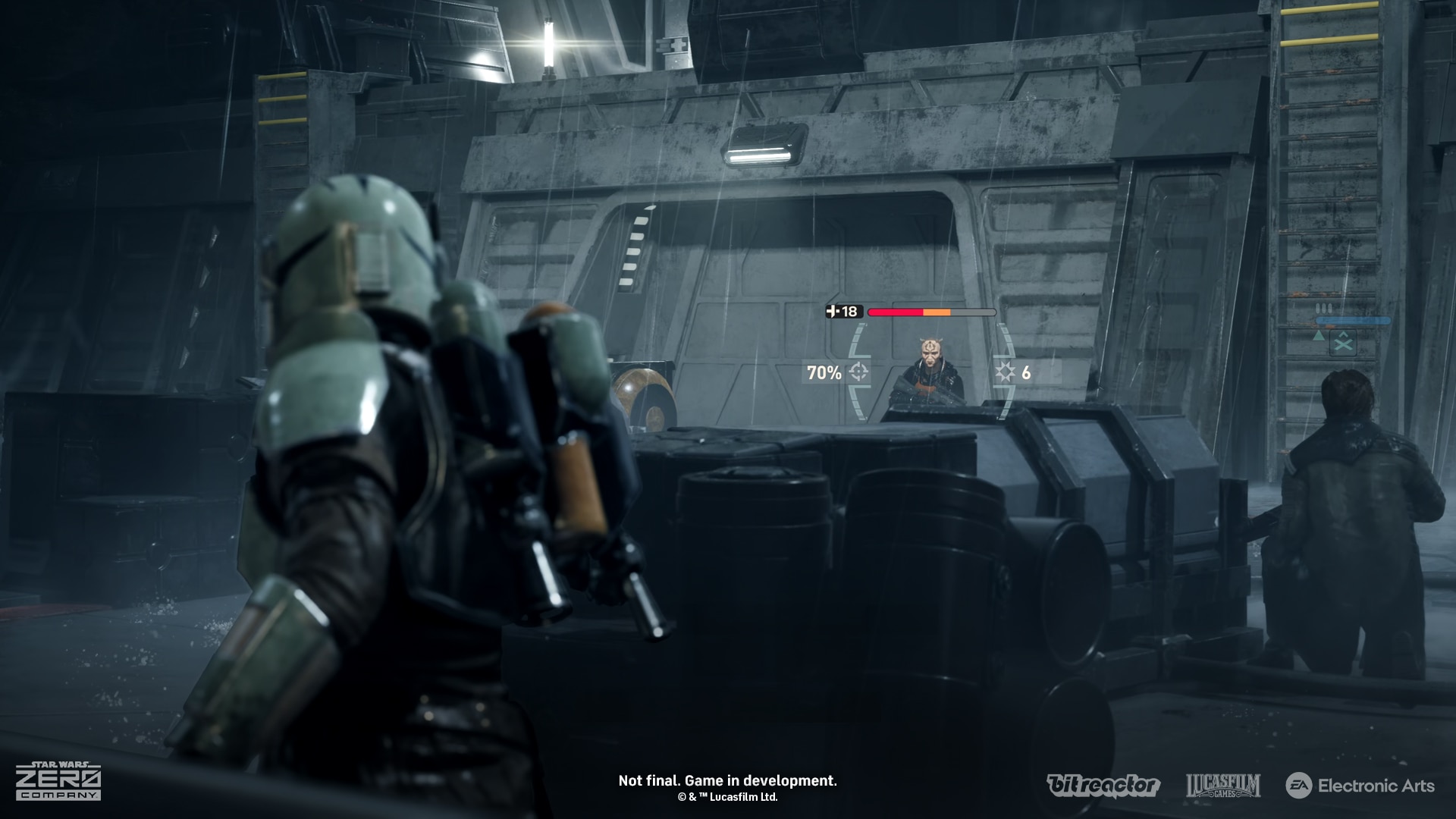
Each attack displays a Chance-to-Hit against the target before you commit. A clean, well-positioned shot can reach 100%; cover and range reduce the chance, while flanking or attacking from higher ground raise it back up. A 70% shot therefore signals that something is working against the attacker, and the game rewards eliminating those factors before firing: the opposite emphasis to XCOM, where accuracy is built up from a lower base. A launch-build bug recalculated a displayed 100% chance lower when the shot was taken, so a shot presented as certain could miss. It was fixed in Patch 1.1 on 9 September 2026.
Statuses
Abilities apply named statuses, shown on the ability card with a stack count (Vulnerable 1, Marked 1), and stack counts are how several buffs scale: Morale, Retaliation, Lethal, Evasion, Harmony, and Sharpened Senses all describe their strength in stacks. Statuses named so far:
| Status | Applied by | Effect |
|---|---|---|
| Vulnerable | Scoundrel, Identify Weakness | The next attack against the target can Critically Hit |
| Marked | Scoundrel, Easy Mark | The Scoundrel Assists the next ally that attacks the marked target |
| Dazed | Soldier, Brutal Strike | Applied on top of the melee damage; becomes Stunned at the ability’s top rank |
| Disoriented | Assault, Sweeping Salvo | Applied to every enemy caught in the cone |
| Morale | Medic, Morale Boost | Restores 2 HP per stack at the start of each turn, then loses 1 stack; while an operator has Morale they ignore Chance-to-Hit penalties from Injury |
| Stimulant | Medic, Combat Stim | Raises Max Health, Melee Damage, and Ranged Damage for 2 turns |
| Retaliation | Heavy, Unstoppable | Each stack permits a counter against the next incoming attack |
| Burn | Cly Kullervo, Combat Jump | Applied to enemies pushed out of position by the jetpack landing |
| Harmony | Tel-Rea Vokoss, Strong with the Force | Stacks each turn, raising Lightsaber Deflection and attack damage |
| Sharpened Senses | Luco Bronc, Combat Gas | Stacks raise percentage Chance-to-Hit |
| Vicious | Cold Blooded (Universal Talent) | Lets the operator score Critical Hits easily |
| Invulnerable | Grit (Universal Talent) | Ignores the damage from an incoming attack; stacks increase with the talent’s upgrades |
| Exposed | Flanking an enemy by moving around its cover | Strips the target’s cover protection |
| Spotted | Scout, The Spotter; Astromech, Deep Target Scan; the Rangefinder utility | Applied to any enemy the Scout damages with their blaster. See Battlefield and Reaction Statuses for what it does |
| Lethal | Sharpshooter, Zero In | Each stack adds +5% Chance-to-Hit and +3% Critical Chance; all stacks are lost on moving or being knocked over |
| Evasion | Anticipation (Universal Talent) | Gained one stack at a time as a Fast Action, on this operator or, at the Talent’s top rank, on an ally |
| Impervious | Heavy, Bulwark at top rank | Immune to status effects |
| Immovable | Heavy, Bulwark at top rank | Cannot be pushed out of position |
An enemy that has been Dazed or Stunned gains Stun Resistance for the rest of that combat, so control effects cannot be chained on the same target: the window they buy is a single turn, and it only comes once.
See Classes for the abilities behind each entry. Vicious and Invulnerable come from the Universal Talents pool rather than from a class ability, so any custom operator can bring them regardless of Specialization.
Statuses that arrive with an ability’s upgrades, rather than at its base rank, are marked as such above: Stunned, Impervious, and Immovable all appear only at the top rank of the ability that applies them. Preview coverage described Morale as a flat +9% Chance-to-Hit per stack lost on taking damage, which the ability data replaces with the healing and injury-penalty immunity shown here. See the class pages for the per-rank values behind them.
Battlefield and Reaction Statuses
Statuses that come from position, terrain, or an enemy’s reaction rather than from a named ability:
| Status | Effect |
|---|---|
| Smoke | Units inside are much harder to hit. Each stack reduces the Chance-to-Hit of ranged attacks by 10%, and the benefit is lost on moving out of the smoke |
| Spotted | Chance-to-Hit penalties from range and smoke are ignored when attacking a Spotted unit. It removes penalties rather than adding accuracy, so it is worth a great deal against a distant or smoke-covered target and nothing against one already in the open at optimal range |
| Scanned | Defense reduced by 4, and attackers gain +20% Chance-to-Hit |
| Shocked | Movement decreased by 50% |
| Stop | A unit hit by an Overwatch attack while moving has a chance to be Stopped, ending that movement immediately |
| Taunt | A Taunted unit must target the source of the Taunt |
| Burning | 1 damage per stack whenever the unit takes any action, ignoring Defense. Taking Burning damage halves the remaining stacks |
| Dart | Links the target to the ElectroWeb. When ElectroWeb Surge triggers, the dart emits an electrical explosion |
| Deflection | An independent chance to block incoming ranged attacks, checked before Chance-to-Hit. Each stack of Harmony adds +4% |
| Reflection | Reflects an incoming attack back at the attacker for the damage it would have dealt |
| Strong Stimulant | +3 Ranged and Melee Damage and +12 Max Health, the stronger form of Stimulant |
Enemy Statuses
Statuses carried by enemies rather than applied to them, which change how a target has to be approached:
| Status | Effect |
|---|---|
| Ray Shield | Attacks cannot damage the unit until the shield is depleted and disabled. It recharges 50% of lost strength each turn |
| Relentless | The unit does not take Cover, but also cannot be Exposed, so flanking gains nothing |
| Machine Learning | Each stack adds +5% Chance-to-Hit to all the unit’s attacks, and it does not expire |
| Shared Suffering | Damage to the protected unit is reduced by 75%, with the connected Guardian taking 25% of it. Defeating the Guardian removes the protection |
Plague Statuses
The Infinite Coil carry Fathom’s plague, and it gives their units a set of statuses that work as a chain rather than individually:
| Status | Effect |
|---|---|
| Infected | The unit carries the plague, and Resonates when nearby Infected units are defeated |
| Resonance | At 3 stacks the plague Surges. When the unit is defeated its Resonance transfers to the nearest Infected unit |
| Surge | The plague has surged, granting the unit greatly increased strength and new powers |
| Plague Armor | Incoming damage reduced by 50% |
| Chromatic Camouflage | The plague warps light and colour around the unit, making it nearly impossible to detect |
The chain is what matters tactically: killing Infected units feeds Resonance into the survivors, and three stacks turns one of them into a Surged unit. Clearing a group in the wrong order concentrates the plague rather than dispersing it.
Defense and Defense Penetration
Defense is the protection an operator gets from armour, toughness, or skill, and it reduces the damage taken from incoming attacks. The Heavy’s Heavy Armor Training passive raises it.
Defense Penetration is the counter to it: an attack carrying it bypasses that protection and deals more damage as a result. The Scoundrel’s Scoundrel’s Instinct passive grants it on that operator’s attacks.
Call for Backup
Call for Backup is a free action costing no AP, usable once per turn by each Operator. It lets that Operator nominate a teammate to assist their next attack: most assisting Operators fire alongside them, while some provide a bonus instead. Because it costs nothing, it adds damage without reducing the actions available that turn.
Strike Penalty
Every weapon has an optimal Range band, listed on the Weapons page. Attacking a target outside that band incurs a Strike Penalty, which is the mechanical reason a Longarm rewards distance and a Blaster Pistol rewards closing in. It sits alongside the other Chance-to-Hit modifiers above.
Squad Size
The standard combat squad is four characters. Players choose which four squad members to deploy from their full roster at the Den before each mission. Certain missions let players control additional characters beyond the standard four.
Terrain and Exploration
A key design feature is that combat is influenced by player exploration. The terrain and layout of a mission area changes based on how the player has explored it prior to or during combat, providing strategic advantages or disadvantages depending on knowledge of the map.
Story missions open with a small third-person free-roam phase: a main-story-only espionage segment where exploring before the fight grants Intel and Advantage Points for the combat encounter ahead. Weather effects during combat are purely cosmetic and do not affect visibility or efficiency.
Cover
Cover is a confirmed mechanic with two levels, and both carry a fixed Chance-to-Hit penalty for the attacker:
| Cover | Chance-to-Hit penalty |
|---|---|
| Full cover | 50% |
| Half cover (Partial cover in EA’s guide) | 35% |
Cover works the same way in both directions: it makes targets harder to hit, and it makes line of sight harder to achieve, for your operators and for enemies alike. Flanking a target by moving around its cover leaves it Exposed, and attacking from higher ground likewise negates the protection cover provides. The game features destructible environments, so cover can be eliminated during combat (a rocket launcher or explosive can clear enemy cover outright), and holding one position too long risks ending up fully exposed.
Environmental kills are confirmed: an enemy pushed into a void (turbolift shafts, water, cliffs) dies instantly. Some enemies can be cloaked, and a droid’s map scan can reveal a cloaked target.
Environmental Kills
Health totals can be bypassed entirely. Many abilities push enemies out of position, among them concussion grenades, Force pushes, and Kabb Uppercut’s Uppercut, and maps are built with catwalks, guardrails, and open drops that make those pushes lethal. An enemy shoved off an edge is removed from the fight regardless of how much health it had left.
This is the efficient answer to armoured, high-health targets. Droidekas, the rolling shielded droids, are singled out as the clearest case: grinding one down through its shield costs a great deal of squad output, while a single well-aimed push does the job outright.
No Fog of War
Zero Company does not use Fog of War. Unlike XCOM, the player can see all enemy positions at all times before engaging. This is a deliberate design departure: in XCOM, concealment of enemy positions was a primary driver of the overwatch-crawl strategy. Without that uncertainty, overwatch becomes a less dominant tactic.
Seeing everything does not mean shooting everything: Bit Reactor notes that snipers still need line of sight, so a full Sharpshooter squad is viable but may land fewer kills than a balanced one. Objective design also pushes against a pure Overwatch crawl; it suits holding ground in supply runs, but sabotage, rescue, and extraction missions all demand movement.
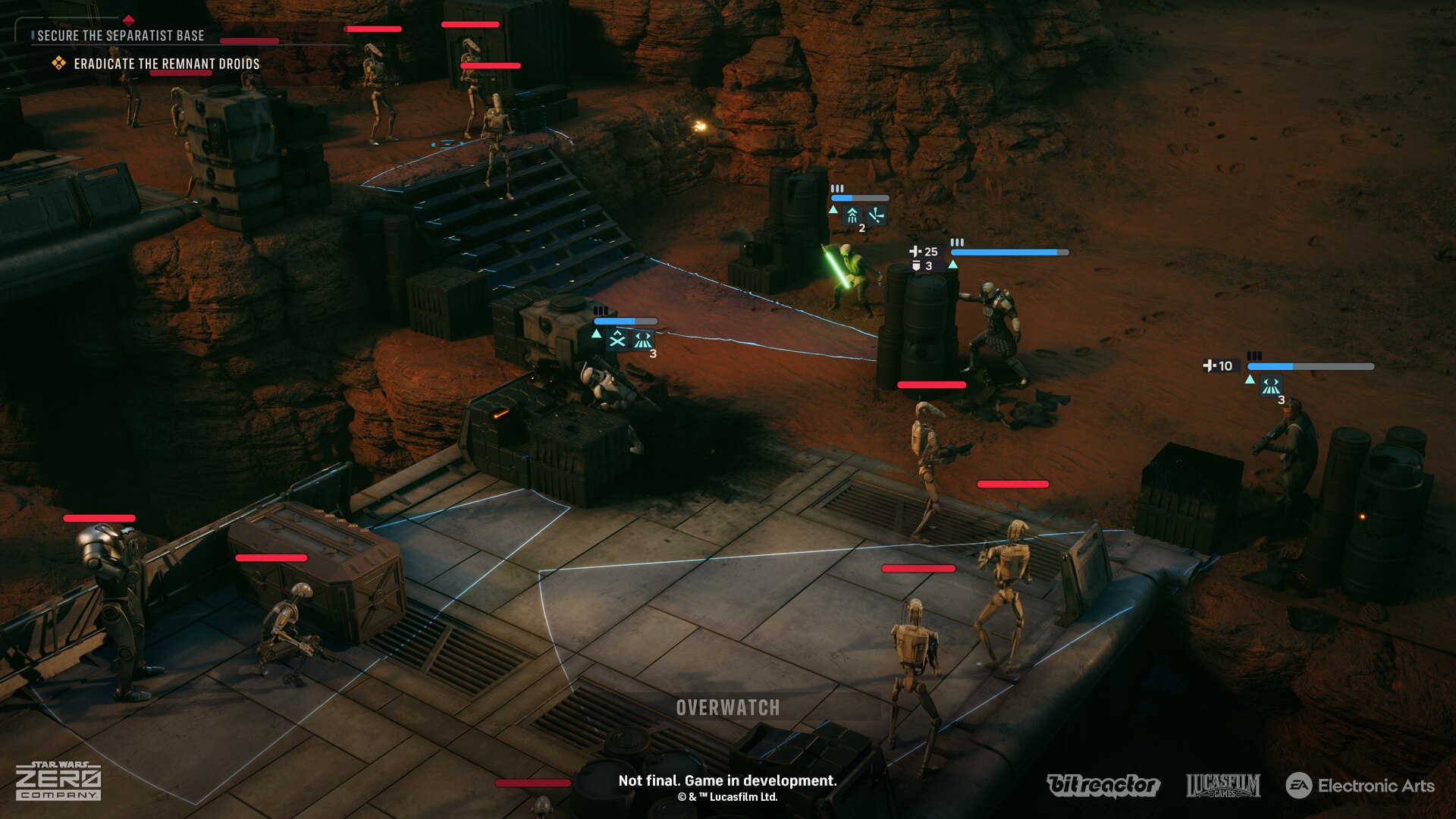
Overwatch in Zero Company is also cone-based rather than omnidirectional: a unit in overwatch covers a defined, adjustable firing arc, and the number of enemies it can fire on scales with the AP invested. The longer the cone, the less accurate the shot, so extending coverage trades hit chance for area. An operator on Overwatch automatically attacks enemies that move through the zone or take an action inside it. Placing Overwatch immediately ends that operator’s turn, making it an ideal final action, and a landed Overwatch shot has a 50% chance to stop the target where it stands, ending its movement for that turn. Combined with the absence of Fog of War and map structures that force players to advance, this pushes squads toward active, forward engagement rather than static defensive play.
Breaking Overwatch: an Overwatch is cancelled outright when the operator holding it takes damage. This is symmetrical, applying to enemies and to your own squad, so shooting a unit that has pinned an approach is a reliable way to clear it before moving through. Enemies use Overwatch to pin down operators in exactly the same way.
Mission Objectives
Missions feature a variety of objectives, including:
- Eliminating all enemies
- Rescuing specific characters
- Defending strategic points
Map layouts vary between close-quarters environments where defensive positioning is appropriate and longer maps where players must advance while completing objectives simultaneously.
Missions that end in an evacuation require the whole squad to reach the evac zone. Operators cannot be extracted one at a time as they arrive, so a straggler holds up everyone, and the retreat has to be planned a turn or two before it starts. The mission ends the moment the last operator steps in, with no turn spent holding the zone, and enemy reinforcements keep arriving until it does.
Glossary
The game’s own tooltip text for the terms used across this page and the class pages. Two entries carry numbers stated nowhere else: the Chance-to-Hit penalty per Injury, and the base Intel reward for a mission.
| Term | Tooltip |
|---|---|
| Special Actions | Special Actions do not cost AP to execute. These actions instead require Advantage. These are powerful, but careful choices for controlling combat situations. |
| Advantage | Used to power Special Actions. Each time an Operator damages an enemy unit, the squad receives 1x Advantage. |
| Fast Actions | Fast Actions cost 1 AP to execute. |
| Action Points (AP) | Action Points are required to move, attack and use abilities. |
| Passive Abilities | Provide benefits that are always active. These abilities never require AP. |
| Health | Health is the amount of Damage a unit can suffer before being defeated. Operators are Downed when defeated, and enemy units are eliminated when defeated. |
| Defense | Represents protection from physical armor, toughness, or skill. Incoming Damage is reduced by an amount equal to Defense. |
| Chance-To-Hit | Determines the chance that an attack on a unit will succeed. If a random roll against this chance fails, the attack will miss and have no effect. |
| Injured | Injured Operators cannot fight effectively and suffer a -10% Chance-To-Hit penalty for each Injury. An Operator who suffers a 3rd Injury is Killed-In-Action and lost forever. |
| Vicious | Each stack guarantees that this Operator's next Ranged Attack or Melee Attack is a Critical Hit. One stack is lost when a Critical Hit is scored. |
| Invulnerable | Prevents all Damage from the next incoming attack. One stack is lost after the attack's damage is blocked. |
| Intel | The currency of information and assets. Intel is primarily used to complete Operations on the Holotable. Missions always reward 100 Intel plus additional bonuses. |
References
| # | Source | Date |
|---|---|---|
| 1 | PC Gamer: Hands-on preview | Mar 2026 |
| 2 | pcgames.de: Exclusive preview (de) | Mar 2026 |
| 3 | Xbox Wire: Tactics Interview (Foertsch & Brawley) | 9 Jun 2026 |
| 4 | EA: Lead Zero Company To Victory | 9 Jun 2026 |
| 5 | EA: Answering the Internet’s Biggest Questions (community Q&A) | 21 Jul 2026 |
| 6 | EA: Operators hub | Aug 2026 |
| 7 | EA Star Wars: gameplay clips (YouTube / X), in-combat ability cards showing action types and statuses | Aug 2026 |
| 8 | Star Wars Zero Company in-game combat, status, and Overwatch behaviour | Aug 2026 |
| 9 | Xbox Wire: Star Wars Zero Company tips (Will Fulton) | 26 Aug 2026 |
| 10 | StarWars.com: How to Play Star Wars Zero Company | 27 Aug 2026 |
| 11 | EA Help: Specialization and Weapon guide | 28 Aug 2026 |
| 12 | EA Help: Turn-based tactics and combat basics | 28 Aug 2026 |
| 13 | Star Wars Zero Company in-game status and keyword tooltips | Aug 2026 |
If information is missing, it has not yet been confirmed. Corrections are welcome.