Permadeath
Overview
Star Wars Zero Company features permadeath: squad members who fall in combat die permanently, removing them from the campaign for good. Crucially, this applies to both custom mercenary recruits and named story characters equally. Every story squadmate is subject to the same permadeath rules as generic Operators.
Hawks is the only exception: as the player character, Hawks is exempt from permadeath. If Hawks dies in combat it is an automatic mission failure and the mission restarts; the campaign does not end.
Design Intent
Bit Reactor co-founder and creative director Greg Foertsch described the thematic rationale:
“Star Wars is about loss. I mean, four years old, watching Obi-Wan Kenobi die, right? It’s about loss — and also, as a developer, wanting people to not save-scum, but to push through the loss to what’s on the other side of the experience, to feel it.”
Permadeath is intended not as a punishing failure state but as a narrative force: the permanent cost of war.
Story Squadmates Are Not Exempt
The decision to apply permadeath to named story characters was contested internally. Narrative lead Aaron Contreras described the development debate:
“There were some fights around how much do we want to limit the impact that a character like [Umbaran sniper] Luco Bronc can have in the story when they can catch a blaster bolt in the face really early on and then they’re gone forever.”
The writing team ultimately accepted it, concluding it made for stronger Star Wars storytelling.
Injury System
Before permanent death, squad members sustain injuries: a graduated wound state that persists between missions until treated. When an operator loses all their Health they are Downed: they can take no actions and suffer an Injury, but an ally can Rally them back into the fight. Accumulating three Injuries results in permanent death on standard difficulty. Key details confirmed by PC Gamer’s hands-on preview:
- Injuries accumulate from combat and remain on a character until you pay for medical treatment at the Den
- Combat is not the only source: Injuries can also be picked up on dangerous Operations launched from the HoloTable, without a Tactical Mission being involved at all
- Rallying costs AP: an ally must spend Action Points to move to the Downed operator and Rally them, so a revive competes with attacking for that turn’s budget
- Improved Rally: a Medic rallying a Downed ally returns them Fully Healed, through the class’s First Responder passive. Any other class brings them back on a fraction of their health, so a non-Medic revive leaves the operator exposed to a second Down, and a second Injury, in the same mission
- Mid-mission revive risk: Rallying a Downed squadmate during a mission is a deliberate risk-reward decision; they may sustain further injuries if they go down again
- Injured reserve: pulling a character off the injured list too early (before full treatment) also carries risk
Injuries carry a combat cost as well as a countdown: an Injured operator suffers -10% Chance-to-Hit for each Injury they are carrying, so a twice-injured operator fights at -20% before cover and range are counted. Two abilities answer that penalty directly, the Medic’s Morale and the Fortitude Talent at its top rank, both of which let an operator ignore it. See Medic and Talents.
This creates a layer of resource pressure between permadeath events; players must manage injury debt across the roster, not just react to deaths. On Hard and Expert the Bacta Tank is disabled, removing instant treatment entirely and leaving a Cycle in a standard bed as the only cure. See Difficulty.
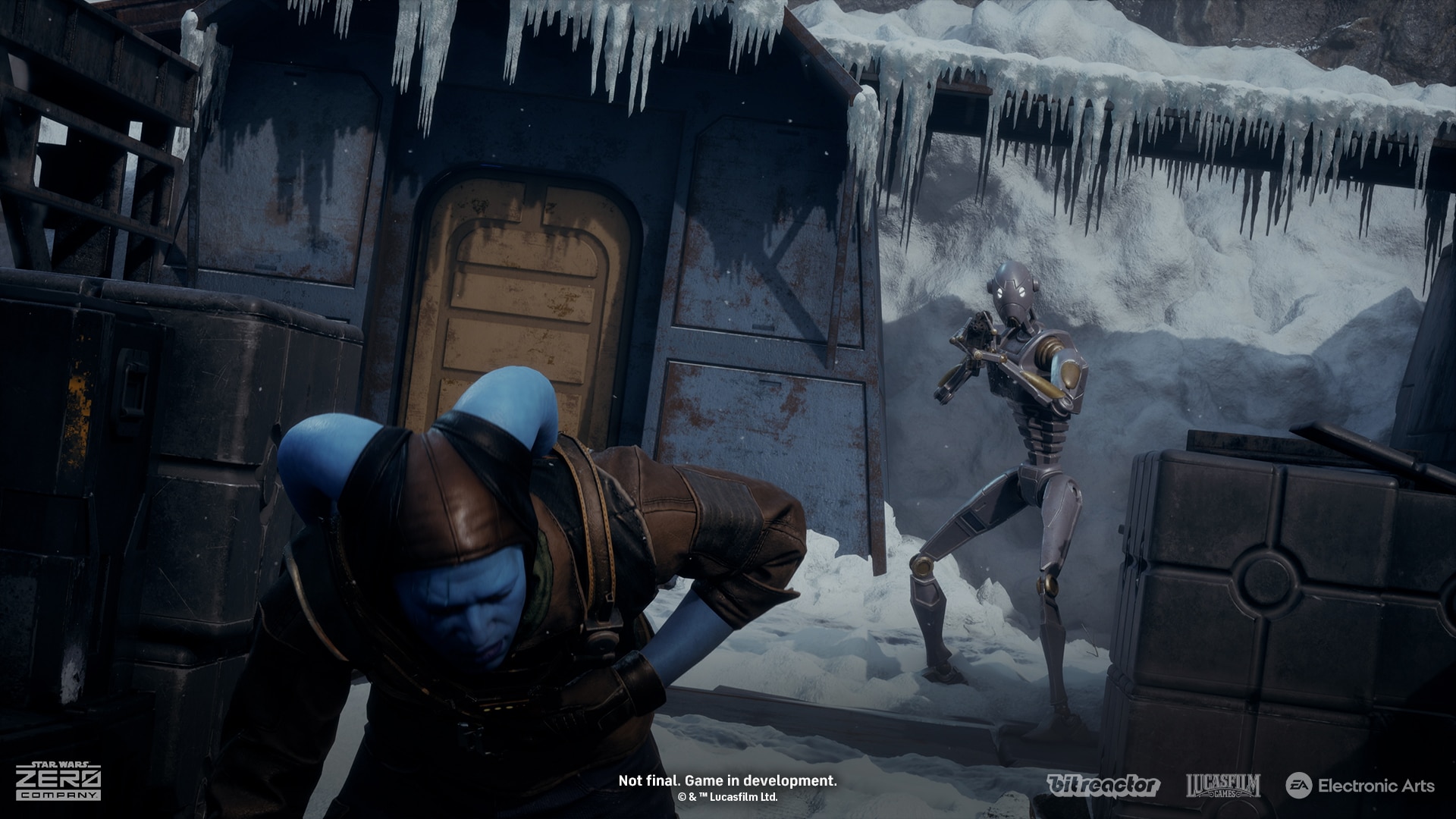
Narrative lead Aaron Contreras noted the system’s origins in development debate:
“About 13 months ago, I lost an argument about permadeath, and it was good that I did, it was the right decision for the game.”
Mitigation
While permadeath is permanent, several systems exist to manage risk:
- Injury treatment: pay to treat injured squad members at the Den infirmary before the next mission
- Recruitment: new squad members can be recruited at the Den between missions, replacing fallen Operators
- Squad management: deploying the right four characters for each mission, and spending Advantage wisely to keep squadmates alive, reduces exposure
- Difficulty settings: four are named, Story, Normal, Hard, and Expert, alongside a separate Beskar Mode that stacks on top of a difficulty rather than replacing one; see Trophies & Achievements. Permadeath is enabled by default and can be turned off on the Difficulty Settings screen when a campaign is created. It cannot be changed afterwards: EA states the setting holds for the entire campaign, so switching it means starting a new one. Greg Foertsch confirmed at the Star Wars Celebration Japan panel: “even permadeath and the limited ability to save your game are available on certain difficulty settings”. Lower difficulties allow players to opt out.
Bond System Interaction
When a bonded squad member dies permanently, those relationships are severed. Surviving characters may react to the loss. See Bond System for details.
References
| # | Source | Date |
|---|---|---|
| 1 | Star Wars Celebration Japan: Announcement panel | 19 Apr 2025 |
| 2 | PC Gamer: “Star Wars is about loss” | Mar 2026 |
| 3 | PC Gamer: Hands-on preview | 26 Mar 2026 |
| 4 | EA: Answering the Internet’s Biggest Questions (community Q&A) | 21 Jul 2026 |
| 5 | EA Help: Turn-based tactics and combat basics | 28 Aug 2026 |
If information is missing, it has not yet been confirmed. Corrections are welcome.